

Reading time: 8 minutes
An additional buy-now button feels like a secure shortcut to checkout. However, skipping the cart might also mean skipping quantity selection, complementary products, or important information.
For Shopify stores, the shortest route is therefore not automatically the best. What matters is which path to purchase fits the product type and the intent of the customers.
Quick & compact
✓ Shopify Buy Now leads directly from the product page to checkout.
✓ It is particularly suitable for simple single-product purchases with high purchase intent.
✓ The cart remains superior for multi-product purchases, additional options, and cross-selling.
✓ Accelerated checkout buttons do not look the same to all visitors.
✓ Test both paths based on orders, revenue, and average order value.
What Shopify means by Buy Now
Shopify refers to the additional button on product pages as an accelerated checkout button. In addition to a brand-neutral version, depending on payment settings, buttons for Shop Pay, Apple Pay, Google Pay, PayPal, or Amazon Pay, among others, can appear.
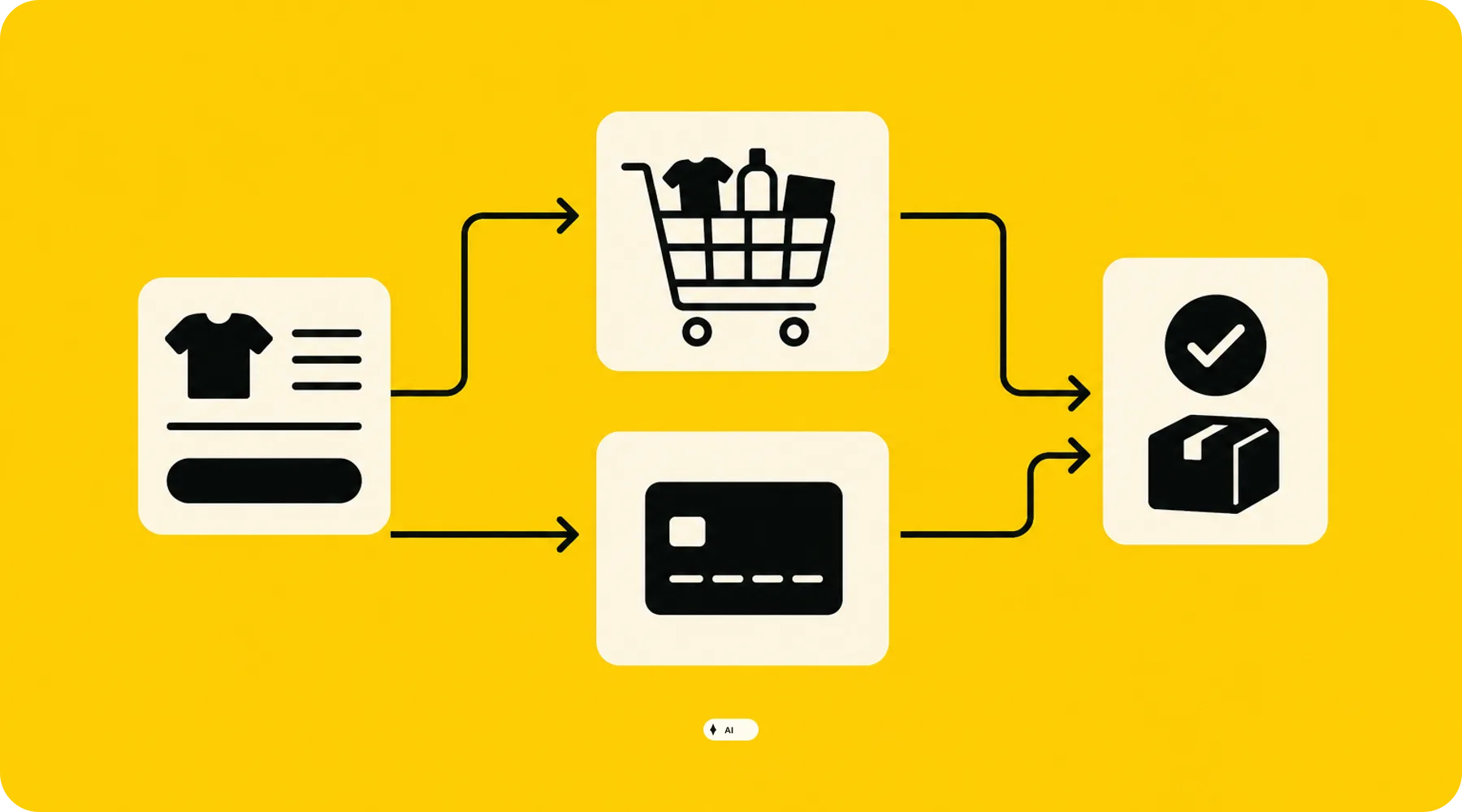
Clicking it skips the cart and leads directly to checkout or to the selected express payment method. The regular button to add to cart remains visible next to or above it.
Which version a person actually sees depends, among other things, on the device, browser, personal payment history, and the activated payment methods. Therefore, you are not testing a completely uniform second button, but a dynamically displayed purchase path.
Important
Do not evaluate Buy Now solely based on your own desktop view. Test the potential buttons on relevant mobile devices and browsers, because the layout and available payment methods can vary.
The two purchase paths in comparison
Buy Now: Fewer steps for clear decisions
The Buy Now option shortens the path between product decision and checkout. This can be helpful when visitors already know exactly which product and variant they want to order.
Strengths of Buy Now
Purchase path: The cart is skipped.
Product type: Especially suitable for simple single items and well-known consumer goods.
Purchase intent: Logical for targeted traffic with lower need for advice.
Risk: Complementary items and cart-related notes are more easily bypassed.
Technically, the path is designed for a single product variant. Customers can buy multiple copies of the same variant, but they cannot compile different variants at the same time using this button.
This makes the Buy Now option more plausible for a frequently reordered skincare product, for example, than for fashion items where multiple colors or sizes are compared and purchased together.
Cart: More control for more complex orders
The classic cart adds an extra step, but in return, it creates a central place to review the order. Quantities, variants, and multiple products can be gathered there before checkout.
Strengths of the cart
Purchase path: The order is collected and reviewed before checkout.
Product type: Suitable for product ranges with accessories, bundles, or frequent multi-purchases.
Purchase intent: Supports visitors who want to expand their purchase.
Risk: An extra step can create unnecessary friction during an already decided single purchase.
The cart is also required if your process uses cart attributes. According to Shopify, these include, for example, gift wrapping, requested delivery dates, or additional selection fields.
Accelerated checkout buttons do not support such cart attributes. Apps that modify the cart, convert currencies, or redirect to an external checkout can also conflict with Buy Now.
Selective use: Different paths per product
The strongest solution is often not a store-wide either-or. Shopify allows you to create alternative product templates and display the accelerated checkout only for selected products.
This allows you to equip simple single products with a Buy Now option, while consulting-intensive items, gift products, or accessory ranges consistently run through the cart. The choice then follows the expected buying behavior instead of a generic theme setting.
Practical check
Start with a clearly defined product group: one product, one typical main variant, little cross-selling, and no required cart fields. This reduces the risk of mixing different purchasing patterns at the same time.
When which path is likely to fit better
Buy Now for focused single orders
Buy Now is a sensible test candidate when campaigns lead to a specific product and most orders contain only this item. This is especially true for repeat purchases, limited drops, or products with a dominant variant.
A low need for explanation also speaks in favor of the shorter path. On the other hand, if buyers need to coordinate scope of delivery, accessories, or multiple designs before ordering, the value of the cart increases.
Cart for product range and building orders
The cart fits better when customers typically combine multiple items. This includes fashion collections, groceries, consumable sets, as well as products with matching spare parts or additions.
The same applies if you collect relevant information in the cart. If Buy Now removes a necessary process step, a potentially higher checkout speed is not a real improvement.
Caution with high cross-selling share
Buy Now can increase the number of completed checkouts and at the same time lower the average order value. This conflict of goals remains invisible if you only look at the store-wide conversion rate.
Therefore, always compare orders and revenue per relevant product page session. Additionally, average order value, units sold per order, and the share of add-on products belong in the analysis.
How to set up a meaningful test
Formulate a concrete hypothesis
A resilient hypothesis describes the target group, expected impact, and potential risk. An example is: For returning mobile visitors of a frequently reordered single product, Buy Now increases orders without worsening revenue per session.
Avoid, on the other hand, the vague assumption that an additional button must generally increase conversion. Different products, devices, and traffic sources can yield opposite results.
Change only the purchase path variant
During the test, pricing, shipping info, product images, campaigns, and discount logic should remain as stable as possible. Otherwise, a change cannot be reliably attributed to Buy Now or the cart.
For a true A/B test, comparable visitors must be distributed to the variants simultaneously. A simple before-and-after comparison is more susceptible to seasonality, advertising pressure, stock levels, and changing traffic quality.
Compare the right metrics
Shopify's conversion report shows the stages from store visit to adding to cart, reaching checkout, and purchase. With Buy Now, however, it is important to note that the step of adding to cart is deliberately skipped.
In this case, a falling add-to-cart rate would not be an independent warning sign. The decisive factors are completed orders, revenue, and the financial quality of the resulting carts.
Measurement rule
Buy Now does not automatically win if more people reach checkout. It only wins if the additional completion performance at least offsets a possible drop in cart value and add-on sales.
Typical poor decisions in comparison
Activating the button everywhere at once
A store-wide activation mixes products with very different buying patterns. As a result, positive outcomes of single items can be obscured by negative effects on more complex products.
Instead, use product templates for a selective rollout. This keeps the cart where variant combinations, gift entries, or cross-selling are part of the purchasing process.
Checking only one visible button
Shopify can display different brand-neutral or branded buttons to different people. Checking on a single browser therefore does not reflect the real customer experience.
Shopify documents special test parameters for previewing supported checkout buttons. Use these to check at least the activated payment methods and your main device classes.
Playing conversion against cart value
A higher conversion rate with a lower order value can still be worse financially. Conversely, a cart with a slightly lower conversion rate can generate more revenue if add-on items are ordered more frequently.
Therefore, do not evaluate the button itself, but the resulting revenue per comparable session. Only this perspective connects UX and business outcome.
What store operators should check now
✓ Identify products with a high share of single-item orders.
✓ Check cart attributes, gift options, and apps for compatibility.
✓ Separate Buy Now and cart products using separate product templates.
✓ Check all activated express buttons on mobile and desktop.
✓ Measure orders, revenue per session, order value, and add-on sales together.
Thinkideas View
Do not use Shopify Buy Now as a global conversion feature. Start with a few, clear single-purchase products and keep the cart as the main path everywhere it actively contributes to building a better order.
Conclusion
Buy Now and the cart solve different tasks. Buy Now reduces steps, while the cart better supports more complex orders, additional information, and cross-selling.
The next logical step is a limited test on a suitable product group. Then decide based on revenue per session and order quality, rather than conversion rate alone.


