

Published: August 2, 2026
Read time: 7 minutes
Black Friday is not won on reach alone. The decisive factors are which customer groups you activate, what offer they receive, and whether profit-driven subsequent purchases result from discount-driven orders.
Since March 24, 2026, Shopify has been managing email automations in Shopify Messaging. This makes now the right time to reorganize segments, automations, and shipping budgets ahead of the peak season.
In brief
✓ Build your Black Friday communication on dynamic Shopify segments instead of a single mailing list.
✓ Separate VIP customers, first-time buyers, inactive existing customers, and subscribers without an order.
✓ Use Shopify Messaging for email campaigns and standard automations, and Shopify Flow for custom workflows.
✓ Calculate shipping volumes, discounts, and contribution margins before creating your campaign.
✓ Plan the post-purchase phase at the same time as the actual Black Friday promotion.
Why Black Friday is a CRM topic
In the peak season, advertising pressure and discount intensity increase. If all contacts receive the same message, you waste existing customer data and risk unnecessarily high discounts for people who would have purchased with exclusive access or a relevant bundle anyway.
Shopify customer segments are dynamic, rule-based groups. As soon as a person meets or no longer meets the defined criteria, they are automatically added or removed.
For campaign planning, this means: You don't have to manually update static lists shortly before every send. Instead, you define purchase-related rules that continue to work throughout the entire Black Friday phase.
Four segments as a solid foundation
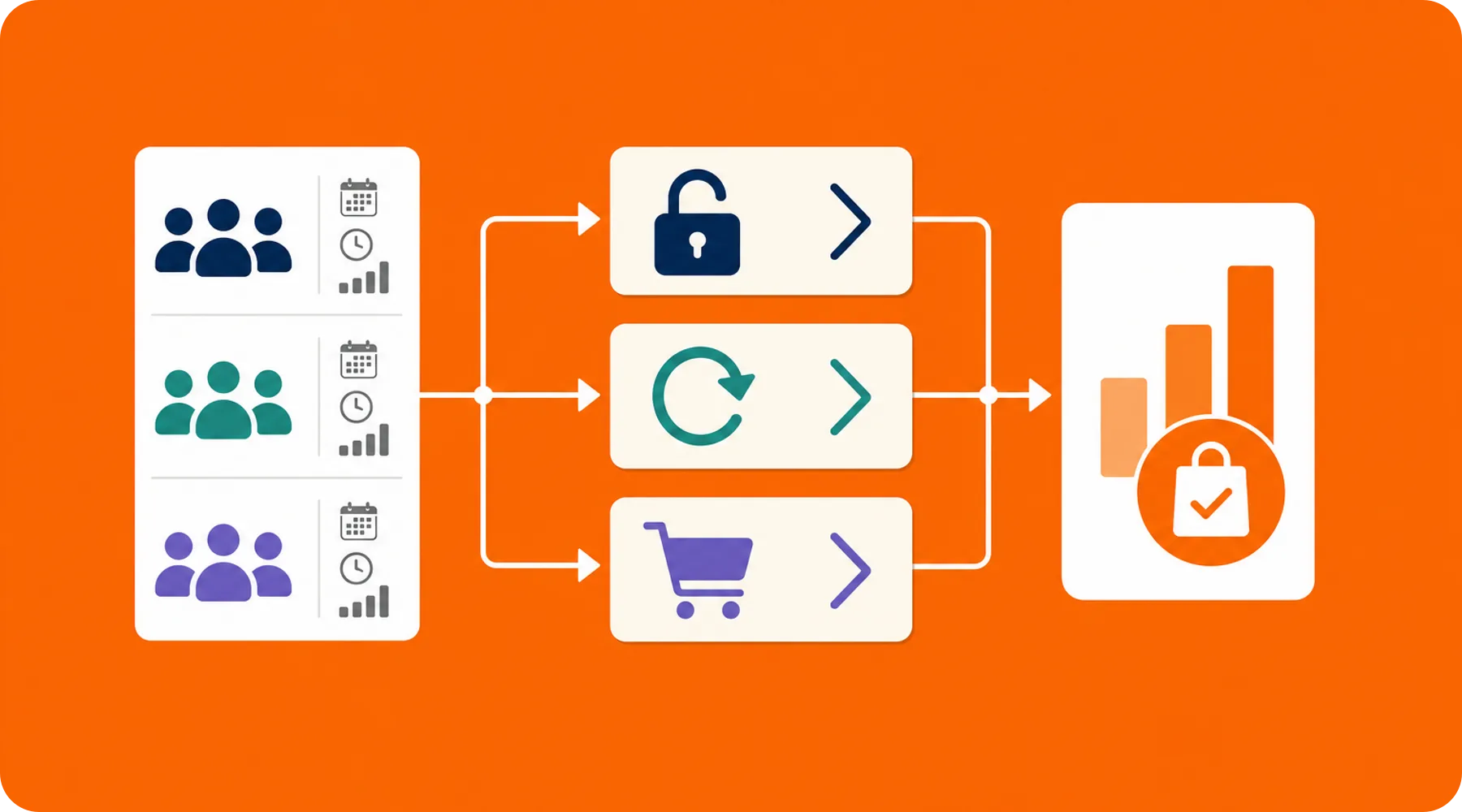
Do not start with as many target groups as possible. Four clearly distinguishable segments are enough for many shops, provided that the offer, message, and economic goal actually differ from one another.
Segment | Example Rule | Meaningful Approach |
|---|---|---|
VIP Customers | Subscribed and at least three orders | Early access, limited bundles, service benefits |
High Purchase Potential | Predicted spend tier "high" and subscribed | Matching new arrivals or higher-value sets |
Inactive Existing Customers | Subscribed and last order at least 180 days ago | Re-engagement with a relevant purchase occasion |
First-time Buyers | Subscribed and exactly one order | Complementary product, usage guide, or second purchase |
The limit values are not universal benchmarks. A consumable product with a six-week repurchase cycle requires different timeframes than furniture, electronics, or high-end accessories.
For shops with more than 100 sales, Shopify can additionally use the predicted spend tier. It is based on purchase frequency, number of orders, average spending, and the timing of the last order, among other things.
Practical Check
A segment only makes sense if it leads to a different decision. If two groups receive the same offer, the same message, and the same sending time, you probably don't need separate segments.
ShopifyQL as a control tool
Segments can be created in the Shopify admin area using templates, the editor, or ShopifyQL. For example, a simple VIP rule can combine email subscription status with a minimum number of orders.
Check the results list after every change. Especially with combined conditions, it is important whether you narrow down criteria with "and" or expand them with "or"; parentheses prevent unexpected mappings in more complex rules.
Planning the campaign in phases instead of single emails
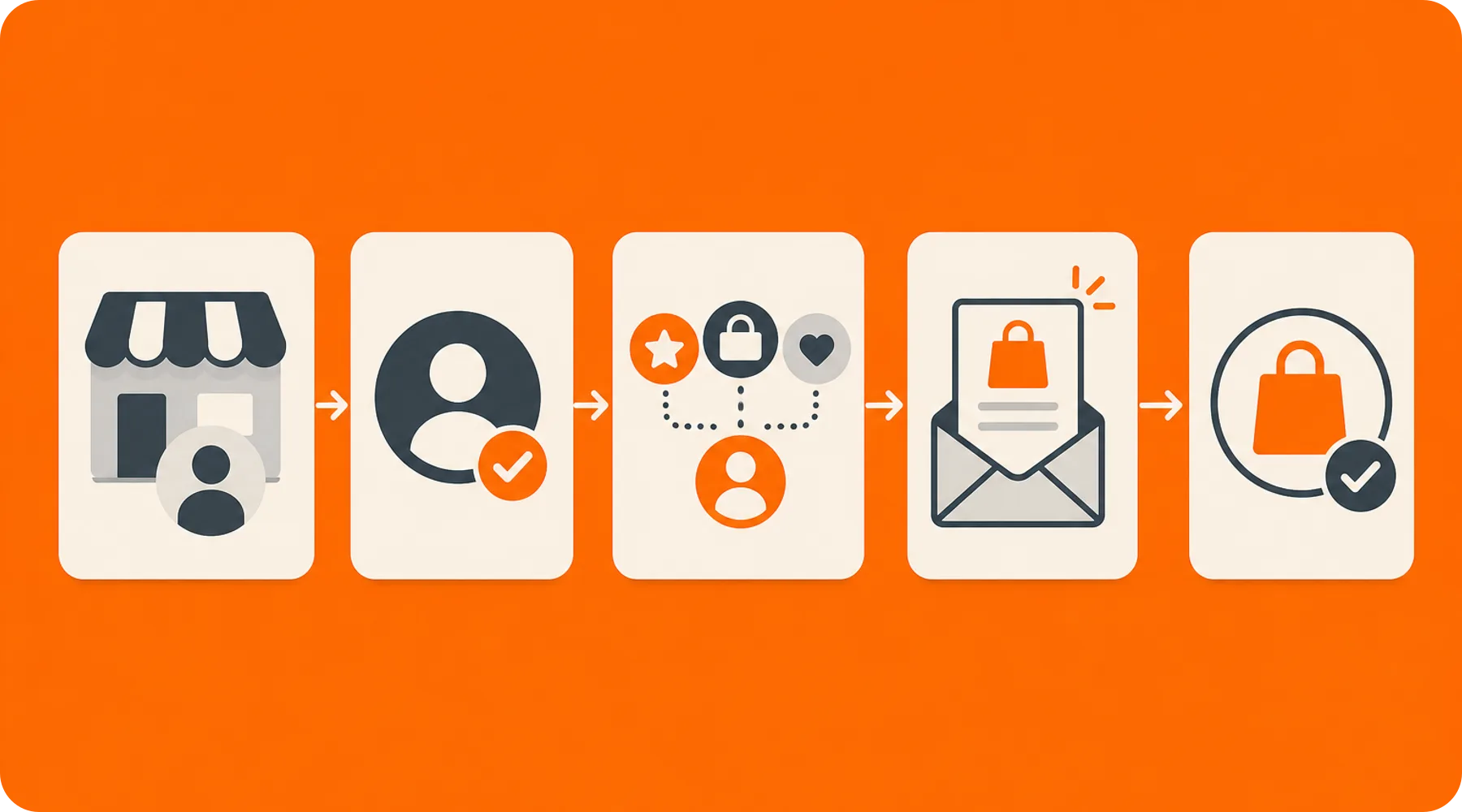
A profitable Black Friday campaign starts before the public discount and does not end when the payment is received. Plan a connected contact journey in which each phase fulfills its own goal.
Phase | Goal | CRM Action |
|---|---|---|
List Building | Gain consents | Form with clear expectations and double opt-in |
Preparation | Identify interest | Communicate product worlds, guides, or wishlists |
Early Access | Activate existing customers | Address VIP and potential segments first |
Main Promotion | Convert demand | Segment-dependent offers and clear deadlines |
Post-purchase | Prepare second purchase | Thanks, application, additions, and win-back |
Early access is not automatically an additional discount. For loyal customers, availability, exclusivity, or a reserved bundle may align better with positioning than a higher price reduction.
For inactive customers, however, communication should provide a plausible reason to return. Check which products this group has previously bought and whether the product range, value proposition, or purchase barriers have changed in the meantime.
Clearly separating Messaging and Flow
Shopify Messaging handles email campaigns and their associated marketing automations. Available templates include those for new subscribers, abandoned product views, carts and checkouts, post-purchase upselling, customer win-back, and VIP welcomes.
Custom automations and workflows with third-party apps can still be built using Shopify Flow. Internally determine which system is responsible for which process so that triggers are not set off twice.
Important
Do not activate any new peak season automation without a test profile. Check segment entry, wait times, exclusions, discount conditions, landing page, and behavior after an order.
Modeling shipping costs in advance
Shopify Messaging includes 10,000 free emails monthly in the Basic, Grow, Advanced, and Plus plans. Every individual recipient address is counted; regular marketing automations count against the quota, while the abandoned checkout automation does not.
Monthly Volume | Official Email Costs |
|---|---|
First 10,000 emails | Free |
Over 10,000 to 300,000 | 1 USD per 1,000 additional emails |
Over 300,000 | 0.65 USD per 1,000 additional emails |
Over 750,000 | 0.55 USD per 1,000 additional emails |
For budgeting, you must consider campaigns and ongoing automations together. A large Black Friday distribution list can exhaust the monthly quota with just one send.
Measuring profitability by segment
Shopify provides metrics such as reach, sessions, orders, conversion rate, and attributed revenue for marketing automations. These values show which automations influenced sales, but they do not replace a full margin calculation.
Therefore, compare at least revenue, discounts granted, cost of goods sold, expected returns, shipping subsidies, and, if applicable, acquisition costs per segment. Looking at the second purchase is particularly important: a discounted first purchase is only strategically convincing if the subsequent customer relationship justifies the initial effort.
In addition, evaluate unsubscribes and spam complaints. A campaign can generate short-term revenue and at the same time weaken the reach of future CRM measures.
What store operators should check now
✓ Have email automations been active in the correct area of Shopify Messaging since the migration?
✓ Do all campaign segments only contain contacts with the required marketing status?
✓ Is double opt-in set up consistently for the German store and any registration apps used?
✓ Do VIP, first-time buyer, and win-back segments actually have different offers?
✓ Have wait times, exclusions, and cancellation conditions for all automations been tested?
✓ Were email quotas, discount costs, and contribution margins calculated together?
✓ Is the post-purchase communication ready before the main campaign starts?
Thinkideas View
Do not treat Black Friday as a maximum blast to the largest possible list. Prioritize profitable existing customer segments first, limit discounts based on actual activation needs, and invest in a robust post-purchase flow before seeking additional reach.
Conclusion
With dynamic segments, messaging automations, and measurable campaigns, Shopify offers a solid foundation for a structured Black Friday CRM. However, the economic difference comes from clear target groups, controlled incentives, and a separate evaluation of the segments.
First, create four core segments and test their mapping with real profiles. After that, you can work out offers, sending sequences, and post-purchase automations on a reliable data basis.


