

Reading time: 6 minutes
Shopify integrated WhatsApp marketing directly into Shopify Messaging on July 29, 2026. Since August 6, relevant consents can also be collected via Shopify Forms.
This creates a new CRM channel in the Shopify Admin for the peak season. However, whether it operates profitably depends less on its reach and more on segmentation, contribution margin, and cleanly measured incremental impact.
In brief & compact
✓ Shopify Messaging has supported WhatsApp campaigns since July 29, 2026.
✓ Shopify Forms can capture consent for WhatsApp marketing.
✓ In Germany, Shopify currently charges 0.248 US dollars per marketing message.
✓ New WhatsApp Business accounts start with a sending limit of 2,000 messages per day.
✓ Before Black Friday, a controlled test with high-value segments is recommended instead of a mass blast.
What Shopify has specifically rolled out
Campaigns from Shopify Messaging
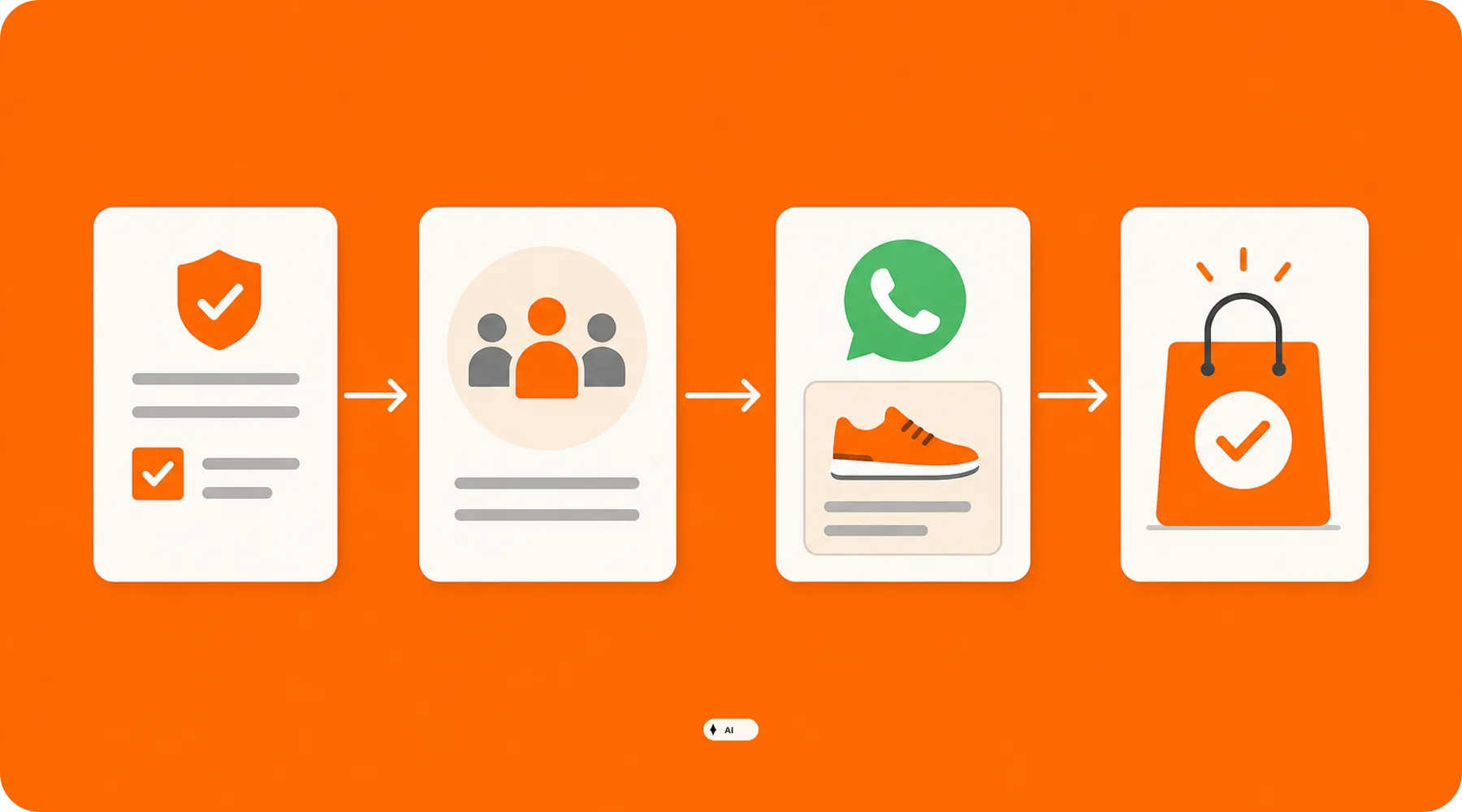
Merchants can create, test, and schedule WhatsApp messages directly within Shopify Messaging. Templates available include sale announcements, product introductions, back-in-stock alerts, and exclusive VIP offers.
Messages can contain text, an image, or a product in the header. Additionally, links, phone numbers, discount codes, and quick replies are possible, among other options. Custom keywords can trigger automated responses.
Consent from Shopify Forms
Shopify Forms now supports WhatsApp marketing alongside email and SMS. To do this, the form must include a phone number field; consent can be captured upon form submission or via a selectable checkbox.
Forms can be connected to customer tags, segments, and Shopify Flow. This allows a shop to track which form a contact was acquired through and separate leads by campaign, interest, or sign-up offer.
Practical Check
Don't just create a single mobile list. Tag the source, timestamp, promoted collection, and incentive used, so that WhatsApp contacts can later be analyzed and targeted in a precise manner.
Why reach alone is not convincing
The sending price changes campaign logic
Shopify charges for WhatsApp marketing per message sent. For recipients in Germany, the Help Center currently states 0.248 US dollars per message. Sending to 1,000 contacts therefore already costs 248 US dollars in pure message fees.
In addition, there may be discounts, creative effort, and the lost contribution margin of regular purchases. Therefore, WhatsApp should not be treated like a cheap newsletter, but rather like a paid contact with a clear sales opportunity.
High purchase intent beats large lists
The channel is particularly plausible for small segments with clear interest: past buyers of a product category, VIP customers, prospects for sold-out items, or customers with high predicted spend potential.
Less convincing is an undifferentiated Black Friday blast to the entire list. Every additional message increases costs, while a portion of the recipients would have purchased anyway via email, paid social, or a direct store visit.
Interaction can be more valuable than the first click
Quick replies and keywords make WhatsApp interesting for high-involvement products. For example, customers can signal interest in a variant or request more information without having to open a new channel.
If a customer replies, a 24-hour service window begins, according to Shopify. Certain service and transactional messages are free within this window; marketing and authentication messages remain chargeable.
Important
Templates must be approved by Meta before sending, which Shopify says can take up to 24 hours. For a number provided by WhatsApp, business and display name verification can also take up to five business days.
How a peak season test should be structured
1. Choose a clear use case
Do not start with the largest segment, but with the strongest buy signal. Suitable options include VIP early access, a scarce back-in-stock item, or an exclusive bundle for returning customers.
The message should contain a single occasion and a clear call to action. Multiple offers, long product lists, and changing discount mechanics make both decision-making and analysis more difficult.
2. Hold back a control group
Open and click rates do not answer whether WhatsApp generated incremental sales. Therefore, split a suitable segment randomly into a recipient group and a control group, and compare order rate, net revenue, and contribution margin.
The decisive factor is the incremental effect: how many purchases would not have occurred without the message? Only this difference should be compared against the sending costs and the incentive used.
3. Set a threshold before the test
Define in advance the minimum incremental contribution margin a campaign must achieve. A positive ROAS based on revenue is not enough if high discounts, returns, or low margins eat up the results.
As a simple decision rule, the incremental contribution margin per contacted customer should exceed the message cost. For Germany, this threshold currently starts at 0.248 US dollars, before other variable costs are taken into account.
4. Scale only after a successful test
According to Shopify, new WhatsApp Business accounts are initially limited to 2,000 messages per day. Individual limitations can also mean that recipients receive fewer marketing messages if they have rarely interacted with them recently.
Therefore, do not plan a critical peak campaign whose success immediately depends on a very large reach. A test in September or October creates time for approvals, list building, segment verification, and reliable comparative data.
What shop operators should check now
✓ Is WhatsApp available in your Shopify Messaging area and fully set up?
✓ Is there already a WhatsApp Business account with another provider that would need to be disconnected before switching?
✓ Do your forms capture clear WhatsApp consent and the required phone number?
✓ Are the consent text, privacy policy, and campaign process verified for your target markets?
✓ Can you analyze opt-in source, segment, sending costs, net revenue, and contribution margin together?
✓ Is there a control group and a pre-defined success metric for the first test?
Thinkideas View
Before Black Friday, do not treat WhatsApp as a replacement for email, but as a paid, high-intensity channel. Start with a small, high-margin segment and only scale if a control group test shows a clear incremental contribution margin.
Conclusion
Direct integration into Shopify Messaging and Forms significantly lowers the technical barrier for WhatsApp marketing. However, the relatively high message price in Germany makes broad, generic campaigns risky.
The next logical step is a limited test with a clear consent source, high purchase intent, and a clean control group. This way, data instead of channel hype determines its use in the peak season.


